
At BCS, we believe that building a best-in-class safety culture requires more than a one-time orientation. While most construction companies provide new-hire safety training, we view training as an ongoing process that reinforces safe practices, builds shared responsibility, and drives worker engagement. Safety is not a box to check or a card to hand out — it is a mindset we cultivate every day.
New hires receive OSHA education and hands-on training that helps them identify hazards and understand our safety procedures. We distinguish clearly between education—delivered through classroom discussion, videos, and presentations—and training, which is practical, applied, and field-focused.
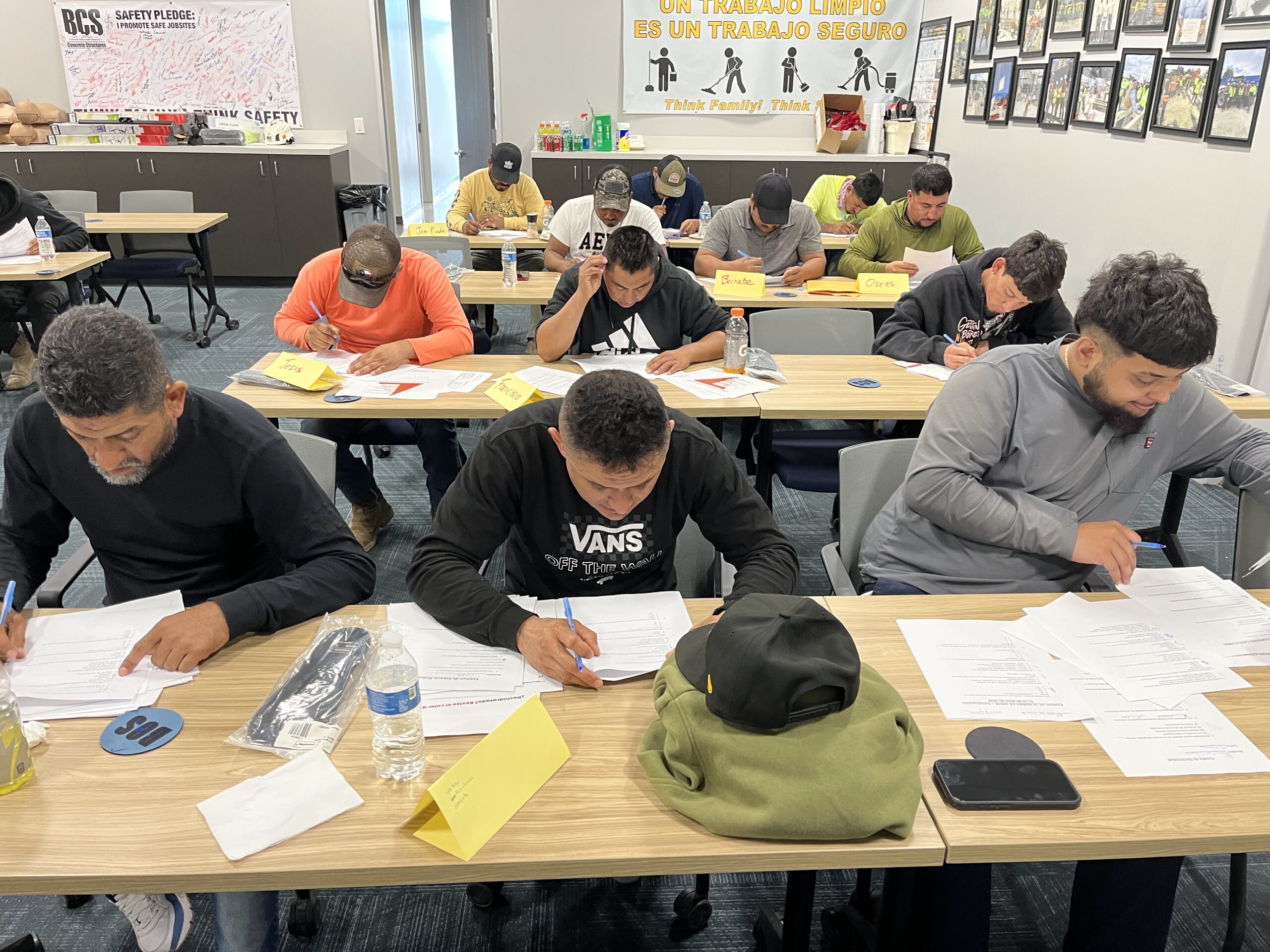
Newly Hired Workers in an OSHA 10 Class.
From day one, every worker is empowered to stop unsafe work. We do not rely solely on safety managers or superintendents; safety is everyone’s job. Our goal is to go beyond compliance and PPE enforcement by helping crews understand why hazards exist and how to eliminate them. Our 30 consecutive months without an OSHA recordable incident and our class leading, 0.67 EMR over the past five years demonstrates that this approach works.
 A Skidsteer Operator performs part of his practical test
In commercial concrete, certain hazards require constant attention. Our leadership development programs and superintendent meetings focus on identifying and solving both operational and safety challenges in the field.
Based on more than 20 years of experience, our most persistent safety challenges include:
- Preventing hand injuries and avoiding pinch points
- Housekeeping
- Controlling exposure to respirable crystalline silica
- Heat injury prevention
- Fall protection and falling-object protection
- Excavation Safety
- Equipment operator proficiency
Empowering workers through focused training helps us mitigate these risks. Encouraging proactive safety behavior and creating an environment where employees feel comfortable reporting injuries further strengthens our culture.
A typical weekly training schedule at BCS may include Forklift Operator classes, First Aid/CPR certification, OSHA 10 for new hires, and Competent Person courses for fall protection or excavation. Our daily JHAs address job-specific hazards as well as seasonal concerns such as heat injury prevention from May through October.
Tracking safety violations and first-aid incidents allows us to identify trends and tailor training accordingly. This data-driven approach has led to improvements such as our 100% glove policy, enhanced equipment-operator training, and our transition to the Kask Zenith safety helmet four years ago.
We also extend our training culture to our general contractors. We invite their employees to participate in our classes, and our safety managers regularly deliver jobsite toolbox talks. Several GCs have even asked BCS to lead training during OSHA’s annual Fall Stand-Down Week each May.
Our annual Safety Rodeo, held this year on December 12, is the culmination of our training efforts. This day-long event celebrates safe performance and features eight simultaneous training stations, along with competitions such as hammering proficiency and a timed forklift obstacle course.
In a competitive Central Texas market, our commitment to training gives BCS a safer workforce and provides added value to our clients. By helping solve safety challenges that impact entire jobsites, we elevate both our performance and theirs.

A group of workers attends a tilt wall safety training before panels are lifted.
To see our past concrete work, visit our portfolio and get a quote from us today.